Today, opening your own front door may require several devices to communicate across a global network with servers running multiple operating systems. Compared with the simplicity of a mechanical lock, it is fair to ask: did we take a wrong turn somewhere?
Revolv sold a smart home hub that let owners control lights, thermostats, and locks. Google’s Nest bought the company in 2014 and stopped selling the hub. In early 2016, Nest announced that it would shut down the cloud service the hubs depended on. After public criticism, Nest refunded the purchase price, but the refund did not bring the devices back.1 Owners were left with working hardware that had become electronic waste, because its vendor no longer wanted to run the servers behind it.
Sustainable software goes further than just consuming less electricity. It stays useful over time, lets people keep using the hardware they already own, and does not waste their resources or time. For many personal devices, extending their useful life can matter more than reducing electricity consumption alone.
I discussed the underlying problems of inefficient software in my TEDx talk on green software. Here, I want to build on that argument: why software decides how long our devices last, why efficiency keeps losing out, and how we can make sustainability part of everyday software development.
The cost of replacing working hardware
Software influences how long a device remains useful. A lack of support can make it unusable, as can requirements that grow with every new release. Every unnecessary calculation, every redundant data transfer, and every task that takes 1,000 steps instead of 10 consumes additional resources. Eventually, people replace devices that still work, because the software no longer runs well on them.
A 2021 review estimated that information and communication technology (ICT) accounted for 2.1% to 3.9% of global greenhouse gas emissions.2 Electricity consumption during use is only part of that picture. For end-user devices, manufacturing weighs at least as heavily. Apple attributes 62% of the life-cycle emissions of a 15-inch MacBook Air (M5) to production and only 27% to customer use, assuming four years of use.3 For the iPhone 18 Pro, production accounts for almost three quarters.4
If you replaced your MacBook Air (M5) with a model that uses 10% less electricity, it would take about 90 years before the savings made up for the emissions of producing the new laptop.5 A 2012 study for the German Environment Agency reached a similar conclusion: a replacement laptop that uses 10% less electricity takes 33 to 89 years to make up for its production emissions.6
Efficient software is also more inclusive software. Students, people on low incomes, and many users in poorer regions rely on older, second-hand, or entry-level devices, often with slow or metered connections. When a banking app, a government portal, or a school platform only runs smoothly on recent hardware, they are the first to be left behind. Rising prices make this worse: in October 2026, Gartner reported that DRAM costs in the second quarter had reached five times their level a year earlier. People now pay more for new PCs, and cheaper models have become harder to find.7
Inefficient software wastes our lives
Even if we set environmental impacts aside for a moment, poor software wastes another valuable and finite resource: human time. Every crash, every wait for a progress bar, and every unnecessarily complicated workflow frustrates and demotivates us. A few seconds for one person add up to an enormous loss across many people and many working days.
A 2023 study by researchers at Roskilde University and the University of Copenhagen asked 234 participants to note every moment of frustration during an hour of their normal computer use. On average, they lost between 11% and 20% of that time to problems with the systems they used. The causes included slow or crashing programs and interfaces that were difficult to understand.8
In a survey published in early 2020 by the British retailer Currys PC World, office workers reported losing an average of 46 minutes a day, or 24 working days a year, waiting for slow or outdated hardware or software.9 That’s almost five working weeks. Imagine getting that time back as a holiday.
The obvious response, and the one a computer retailer would suggest, is to buy faster computers. But new hardware brings back the manufacturing emissions discussed above, and faster processors have never kept software fast for long. We have to improve the software instead and design it so that people can complete their tasks without unnecessary obstacles.
Why efficiency gets left behind
Developers can use dependencies and abstractions to make software easier to build and maintain, but unnecessary layers can hide resource costs from them. In everyday project work, teams often find it easier to justify adding another function than spending time improving the ones they already have.
Hardware manufacturers compete on battery life and performance per watt, so efficiency directly affects their sales. Software vendors have weaker incentives. Inefficient server code at least shows up on the vendor’s hosting bill. An inefficient app or website, however, runs on the users’ devices. They pay for the electricity, the data volume, the waiting time, and eventually the new device. The vendor rarely sees any of these costs, so when budgets are allocated, new features usually win. The common argument that developer time is more expensive than computing time leaves out the costs that users pay. Whether an optimization is worthwhile depends on the full costs and benefits, including how often the software runs.
As hardware gets faster, developers can afford approaches that are quicker to write but use more resources. In 1995, Niklaus Wirth summed up the result in his essay A Plea for Lean Software, citing Martin Reiser: “Software is getting slower more rapidly than hardware becomes faster.”10 The observation has since become known as Wirth’s law.11
Regulation is catching up
Not everything is left to the market. In the EU, lawmakers have started to set rules that protect buyers and hold companies accountable for their impact.
Since June 2025, people buying a smartphone or tablet in the EU can count on operating system updates for at least five years after the manufacturer stops selling the model, provided it offers updates at all.12 The Cyber Resilience Act extends this idea to hardware and software products in general. Buyers will learn at the time of purchase how long a product receives security updates, and as a rule, that period must be at least five years.13
The Corporate Sustainability Reporting Directive (CSRD) requires large companies to report how their business affects people and the environment, and how sustainability issues affect their business.14 The accompanying reporting standards address resource use and the circular economy, including sustainable product design.15 Green coding is not explicitly required by the directive, but nothing stops us from improving our software too.
Small savings, large effects
Wikipedia shows what sustainable software development can look like in practice. In 2019, its developers reported reducing its compressed JavaScript startup manifest from 36.2 KB to 27.2 KB, saving 4.3 TB of data transfer every day. This was no easy change and required a year-long effort. The teams worked toward a size budget of 28 KB by removing unused code, combining modules, and reducing the metadata sent to browsers.
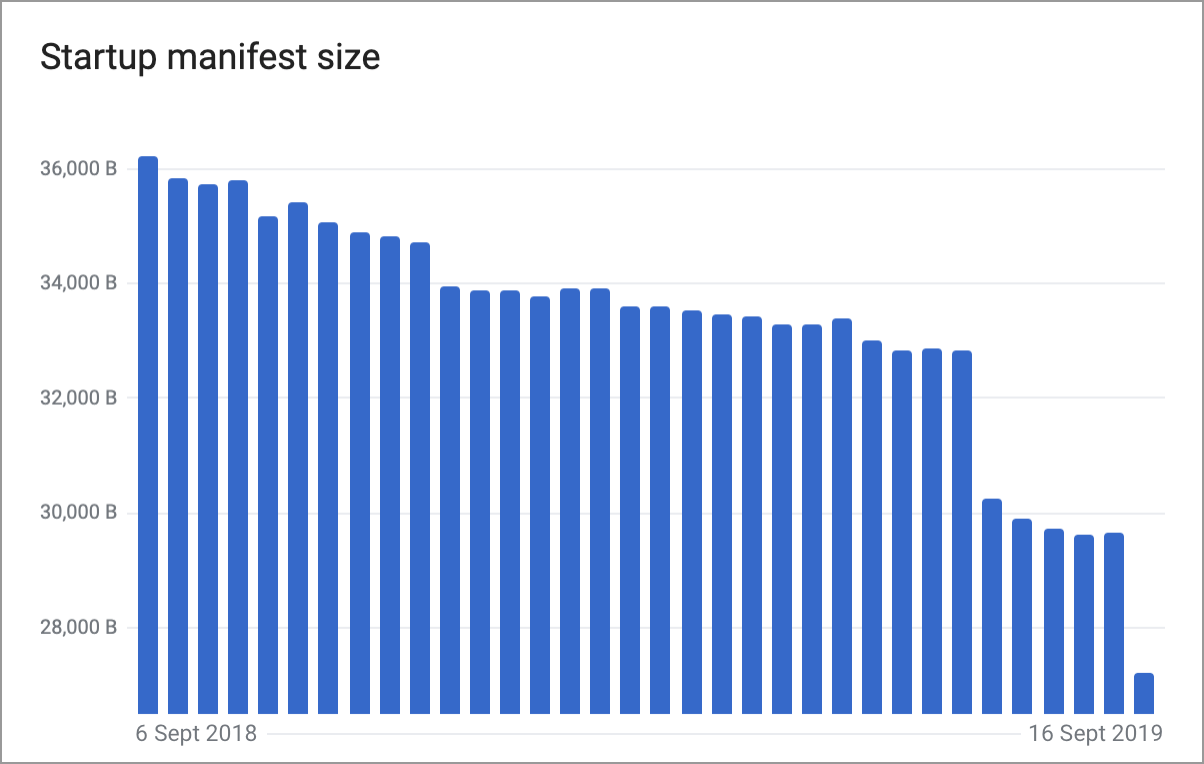
The project lead tracked progress and potential regressions in a spreadsheet, then automated the monitoring through a public dashboard.16
Those 4.3 TB per day are hard to convert into emissions, because much of a network’s energy use is needed regardless of how much data flows through it. The clearest benefit goes to people with older phones or slow connections: their browsers have to download and run less JavaScript on every page view.
Most projects do not have Wikipedia’s reach, but the same practices apply: set a resource budget, measure progress, and watch for regressions.
Teams can test on old and low-end devices, not just on the developers’ latest laptops. They can set performance budgets for the slowest devices they want to support. And they can make minimum operating system and browser versions a deliberate decision. Before raising those requirements, it is worth asking how many people the change would leave behind.
Putting numbers behind sustainability goals
To measure whether a change actually helps, the nonprofit Green Software Foundation developed the Software Carbon Intensity (SCI) specification.17 It has also been published as ISO/IEC 21031:2024.18 SCI expresses emissions per unit of work, such as an API request or a user-hour. It combines operational emissions with an allocated share of the emissions embodied in the hardware, then relates them to the chosen functional unit.
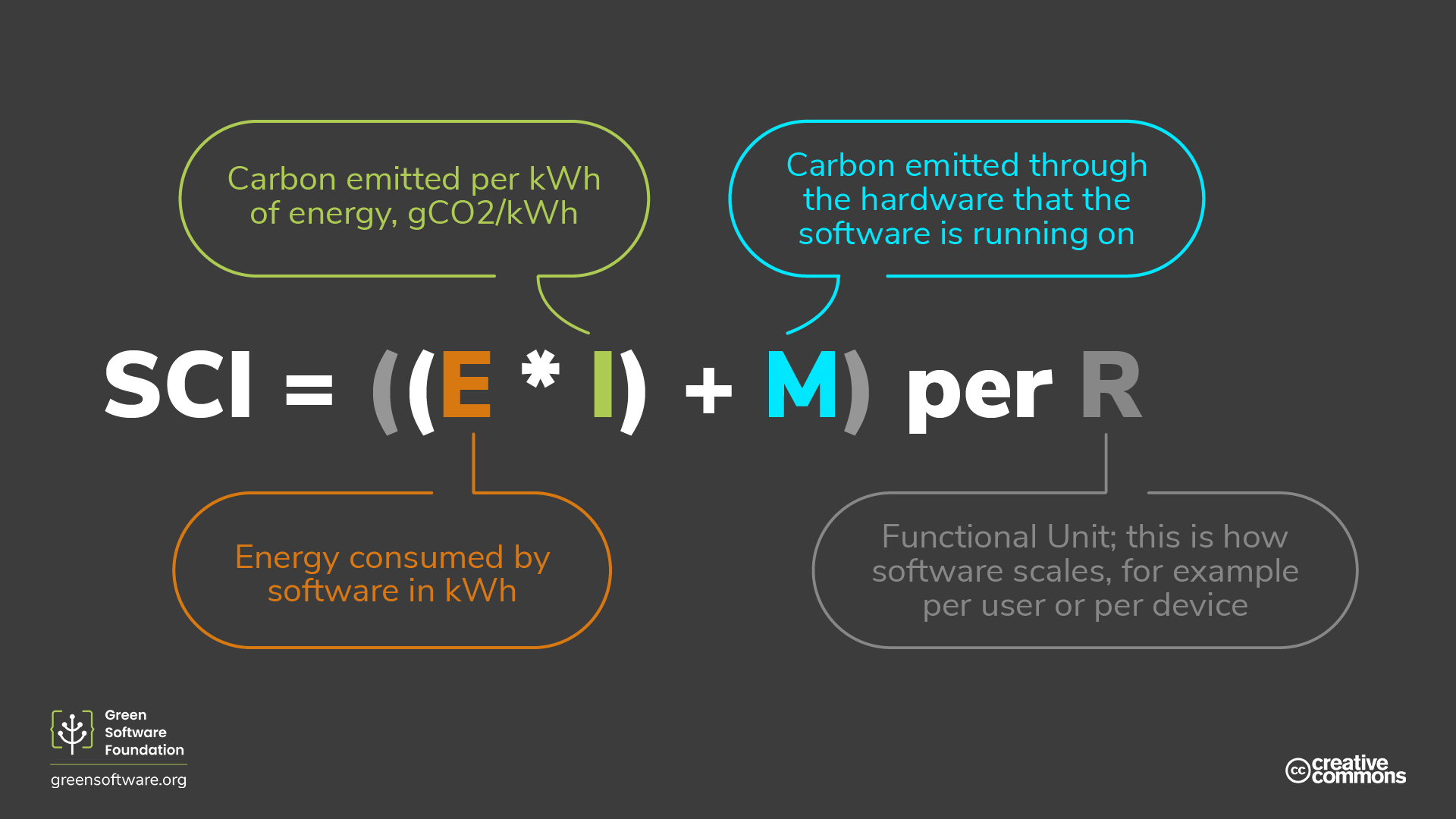
Teams can use SCI to compare architectures, hosting regions, or caching strategies. These decisions involve tradeoffs, so we need to measure the overall result rather than a single resource. A metric alone does not make software sustainable, but it provides a basis for setting reduction targets and tracking progress.
Remember that the SCI covers emissions per unit of work, not overall system emissions. Efficiency improvements can backfire if they encourage enough additional use to more than offset the resource savings, causing total resource consumption to rise.19 SCI also does not cover every aspect of sustainability discussed in this post.
The Green Software Foundation brings together research institutions and companies such as Microsoft and Google. There is some irony in software giants helping to write the rules for consuming fewer resources. As both expand their data centers for AI, Google’s reported carbon footprint in 2025 was 81% higher than in 201920, while Microsoft’s reported emissions in its 2025 fiscal year were around 60% above its 2020 baseline.21 I am glad they are involved. I would be happier still to see the results.
Security and sustainability share root causes
My employer, SBA Research, has also joined the foundation, and I serve as the point of contact for our collaboration.22 Working in information security, I encounter many of the same problems that make sustainable software development difficult: unnecessary complexity, code that is hard to maintain, and a lack of understanding of what a system actually does.
Sometimes, I find exposed services during my penetration tests that the customer has forgotten about but that still consume resources and require security patches. During source code reviews, I see tiny applications or features requiring large numbers of dependencies because including them was easier than writing a few lines of custom code. Every forgotten service and every unneeded dependency is both an attack surface and a resource cost.
These problems reflect what we accept as good software and what we reward in its development. Raising that standard means making security and sustainability part of what we teach, what we measure, and how we judge a project’s success.
Build less, build it better
One approach to reducing overengineering is digital sufficiency.23 It asks which digital functions we actually need and how much technology is appropriate to provide them. Features that add little value could become optional modules, although every option adds code paths that have to be tested and maintained. Often, the better choice is to leave them out altogether.
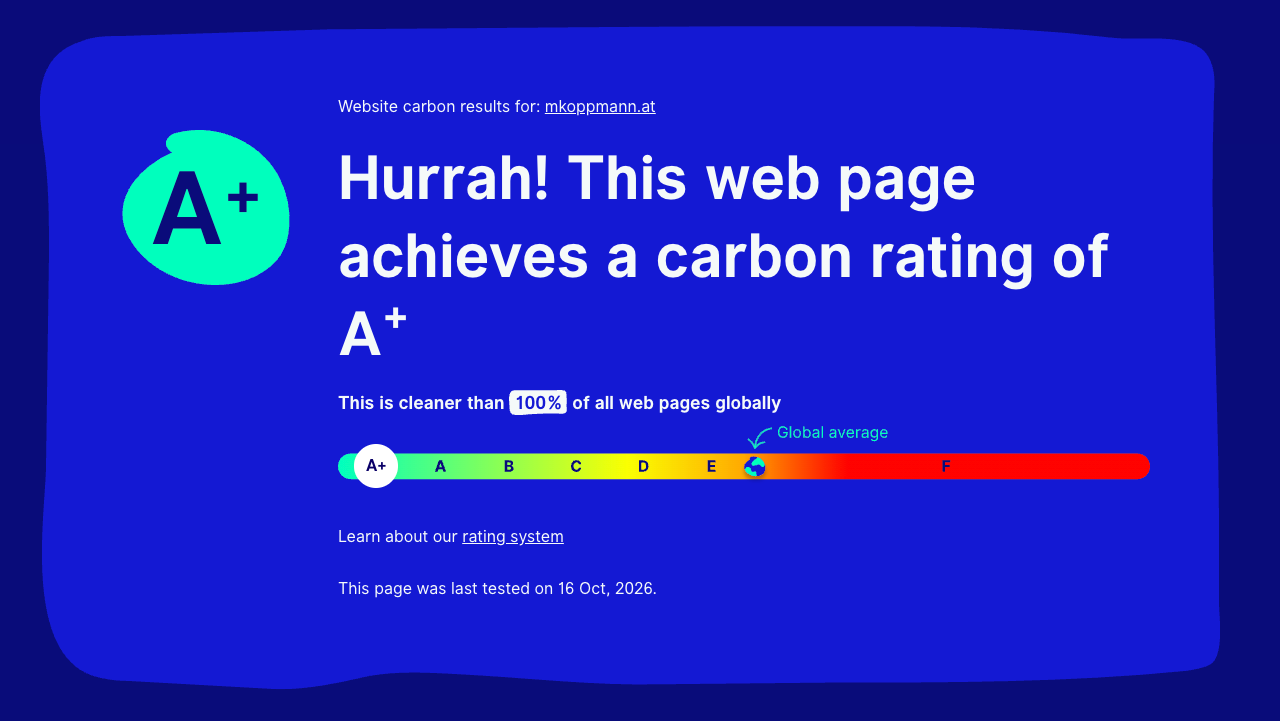
Tools such as Website Carbon can offer an initial indication of a web page’s footprint. On October 16, 2026, the calculator gave my homepage an A+ rating and estimated emissions of less than 0.01 grams of CO₂ per page view.24 These figures come from a model, not from measured electricity consumption.
The Web Sustainability Guidelines, developed at the World Wide Web Consortium (W3C), offer practical recommendations for design, development, operations, and product management.25 Besides the familiar advice about removing unused code and optimizing media, they contain some suggestions that go beyond pure efficiency:
- Reduce or switch off resource-heavy features when grid demand or system load is high, explain the change, and let users restore full functionality.
- Use browser features such as the Page Visibility API to pause media and background work while a tab is hidden.
- Use semantic, standards-compliant markup and support assistive technologies, so more people can use a site without heavier code.
- Avoid deceptive patterns and designs that keep people engaged longer than they need, because every unnecessary minute and page view costs energy and attention.
I made many design decisions during my website redesign, guided by one main principle:
Prefer build-time costs to runtime costs.
I chose a static site generator because I update my personal website only occasionally.
This way, I avoid using a database and running a web application that requires ongoing security updates.
HTML is generated during the build, and a web server can efficiently serve compressed files to visitors.
The build process also creates images in multiple sizes and efficient formats, letting the browser choose an appropriate version for the device.
For example, one generated variant reduces a 6.7 MB JPEG at 3984×2656 pixels to a 23 KB AVIF at 480×320 pixels.
Most of that saving comes from the smaller dimensions, but the JPEG at 480×320 pixels would take 42 KB, still almost twice as much.
I use system fonts and native browser features so visitors download no fonts and less JavaScript.
The table of contents on this page is a <details> element, and footnote previews use the Popover API.
It also helps that I don’t run any user tracking software, which saves me and my visitors a lot of trouble.
Sustainable software follows many of the same principles as good, fast, usable software. Looking at the environmental impact makes the consequences of ignoring these familiar best practices more visible.
It takes all of us
Each time we developers give up a little performance for convenience or accept a few extra megabytes of memory use without asking whether the tradeoff is worthwhile, the decision may seem harmless on its own. Together, many such decisions have made software heavier than it needs to be. Their environmental and social costs don’t stay with the companies that make the software. They land on the people who use it and on the planet.
Developers can start by measuring the resource consumption of a frequently used task, improving it, and checking that later releases preserve the gains. Managers can give that work time and funding and make support for existing hardware part of the product’s requirements. Policymakers can enforce support commitments and push for ways to keep devices usable when the services behind them shut down. When choosing software or connected devices, we can ask how long they will receive updates and whether they will keep working if the vendor disappears or loses interest.
We need sustainable software because the devices people own, the time they spend, and the planet they live on are too valuable to waste.
Notes
-
Closing letter to Nest Labs, Inc. on the Revolv shutdown (FTC File No. 162-3119), Federal Trade Commission. ↩
-
iPhone 18 Pro and iPhone 18 Pro Max Product Environmental Report, Apple. ↩
-
My calculation from Apple’s figures, assuming the new model causes similar production emissions: production accounts for 62% of 145 kg CO₂e, about 90 kg. Customer use accounts for 27%, about 39 kg over Apple’s assumed four years of use, or 9.8 kg per year. Using 10% less electricity saves about 1 kg per year, so offsetting 90 kg takes about 90 years. ↩
-
Timely replacement of a notebook under consideration of environmental aspects, German Environment Agency. ↩
-
Gartner Says Worldwide PC Shipments Declined 22.4% in Third Quarter of 2026 As Component Cost Inflation Raised ASPs, Gartner. ↩
-
Frustration: Still a Common User Experience, ACM Transactions on Computer-Human Interaction. ↩
-
Tech Troubles: The true cost of outdated workplace tech, Currys PC World (on archive.org). ↩
-
A Plea for Lean Software, IEEE Computer. ↩
-
A similar joke is known as Andy and Bill’s law: “What Intel giveth, Microsoft taketh away.” Hardware improvements under Intel’s Andy Grove were swallowed up by the growing resource demands of Microsoft’s software under Bill Gates. ↩
-
Commission Regulation (EU) 2023/1670 — ecodesign requirements for smartphones and slate tablets, Annex II, EUR-Lex. ↩
-
Regulation (EU) 2024/2847 — Cyber Resilience Act, Article 13, EUR-Lex. ↩
-
Corporate sustainability reporting, European Commission. ↩
-
Wikipedia’s JavaScript initialisation on a budget, Wikimedia. ↩
-
Software Carbon Intensity Specification, Green Software Foundation. ↩
-
ISO/IEC 21031:2024 — Software Carbon Intensity (SCI) specification, ISO. ↩
-
This is also known as Jevons paradox, Wikipedia. ↩
-
Google 2026 Environmental Report, Google. ↩
-
2026 Environmental Data Fact Sheet, Microsoft. ↩
-
Engineering Secure and Sustainable Software—Meet Michael Koppmann of SBA Research, Green Software Foundation. ↩
-
Digital sufficiency: conceptual considerations for ICTs on a finite planet, Annals of Telecommunications. ↩
-
Website Carbon Calculator — results for mkoppmann.at, Wholegrain Digital. ↩